




 Click it and Unblock the Notifications

-
St Andrews College
Accreditation & Recognition
Established
Affiliation
About St Andrews College
St. Andrew’s College, Gorakhpur was established in 1828.
St. Andrew’s College, Gorakhpur, named after Saint Andrew, one of the first twelve disciples of Jesus Christ, had a humble beginning as a Mission School by the Church Missionary society to provide education primarily to Christian children but also to others irrespective of creed that voluntarily joined it.
The foundation of the Church Missionary Society (C.M.S.) in 1699 was consequential to the Evangelical Revival, with the role of great grandfather of Indian Evangelical Revival being ably played by the Rev. Charles Simeon. It was in 1899, when a new impetus was given to the moribund state of development of Anglican Communion colleges in India.
It grew into a college in 1899. The college is presently run by the Lucknow Diocese of the Church of North India and is managed through the St. Andrew’s College Association and its Governing body comprising the experienced educationists and a few leading citizens of Gorakhpur under the Chairmanship of the Bishop of Lucknow. Gorton, a retired civilian gave money from a fund to form a special endowment for the Himalayan Mission. C.M.S. had a small mission statement in the Himalayas. Michael Wilkinson was the real founder of Gorakhpur Mission.
He built a small parsonage and laid the foundation of the church. Roberts Merltins Bird, one of the eminent civilians of his generation was largely responsible for devising the system of assessing and collecting the land revenue in Upper India. In 1823 he was stationed at Gorakhpur, in the extreme North East of the region, the borders of Nepal. In 1826, this Church was open to both English and Indian Services. The missionaries were able to proselytize many in the region and Bettiah became the epicenter of the Roman Catholic families.
In those days barren malarial jungles infested Gorakhpur all around.
The then Governer General of India Lord William Bentick donated 1500 acres of this land to the patronage of Church Missionary Association of Gorakhpur. It was done on a nominal rent and the latter took the uphill task of clearing and cultivating the whole land in its own hand. It was able to shoulder the mantle for 500 or 600 acres of land and with the aid of grants a 'Gospel Town' was built in Basharatpur. Houses were made slightly elevated due to unhygienic base.
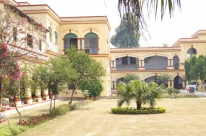
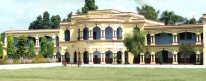
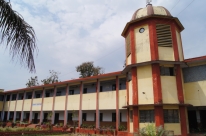
Then came the landmark for the education scenario in Gorakhpur in the year 1899, when the Church Missionary society founded St. Andrew’s College. It disseminated from a small missionary school in 1828 to becoming a full-fledged degree college since 1899 onwards. Its founder principals were Revd. T.F.Robathan and Revd. R.J.Kennedy. In 1914, the builder of Science Department at St. John's College, Agra and the editor of the famed war journal donned the mantle as the principal of the college. Around 1916 degree classes started in this college during the tenure of Garfield Williams. He retired in 1918 before which time he had also designed the architecture of the college; the circular library being its hallmark. In the interregnum Bishop George Herbert Wescott laid the foundation stone of the college. That was on 16th August, 1915, which was opened on the epiphany day i.e. 6th January, 1916 by Sir James Scorgeimeston, the then Lt. Governer United Provinces of Agra and Oudh and also the chancellor of the University of Allahabad. Then ensued a lull until Principal M.O.Varkey got added for the college a Biology block and a recreation center in 1958. Principal V.M.Chacko contributed to the college through the building of Chemistry and Administrative blocks. The extension of Botany, new library building and the extension of Zoology block too were added to the main building by Principal H.R.Mall in the years 1987, 1988 and 1991 respectively.
The extension of the main office building and the facility of the staffclub-cum Guesthouse etc. are in the offing. Another block of lecture theaters is being constructed by Principal J.K.Lal.
From 1899 to 1927, the college got its affiliation to Allahabad University and to Agra University from 1927 to 1958. There after it remains affiliated to Gorakhpur University. It will be worthwhile to recall that the principal V.M.Chacko conceived the plan for the evolution of University of Gorakhpur.
As of now, St. Andrew’s College retains the epithet of 'Oxford of Eastern Uttar Pradesh'. With postgraduate classes also in Science, arts and the only Christian College in India ornamented with the faculty of Law, St. Andrew’s has truly come of age all these decades. Small wonders its present student strength has crossed the 4500 mark. And the faculty members have risen to 86. Many UGC sponsored projects run in our science laboratories.
The college has been famous for its competent Principals, the most prominent among which has been its first Indian Principal Dr. Raja Ram (1937-40), who left St. Andrew’s to become the Principal of St. Stephen's College, Delhi, from where he had come. Other big names include Rev. Arnold Pelly(1918-34), eldest son of Rev. Cannon Pelly of Wickham Bishop's Essex, who married Constance Emily Stern, daughter of Rev. Henry stern, CMS missionary and founder of Sternpur, Padribazar, Gorakhpur, Principal P.T.Chandi (1952-55) and Dr. Y.B. Singh (1970-81), retired as Vice-chancellors of Gorakhpur and Rohilkhand Universities.
| Streams | Mode | Duration | Eligibilty |
|---|---|---|---|
| Master of Arts in Hindi | Full Time | 2 Years | B.A |
| Master of Arts in Political Science | Full Time | 2 Years | B.A |
| Streams | Mode | Duration | Eligibilty |
|---|---|---|---|
| Bachelor of Science in Biology | Full Time | 3 Years | XII |
| Bachelor of Science in Maths | Full Time | 3 Years |
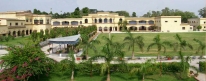
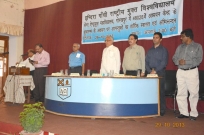
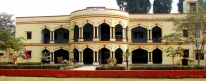
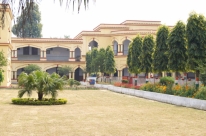
- Library
- Sports
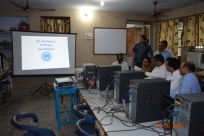
- Classroom
- N.C.C.
- N.S.S.
- Cafeteria/Canteen