




 Click it and Unblock the Notifications

-

Orissa University of Agriculture & Technology (OUAT), Bhubaneswar
Type of College
Accreditation & Recognition
Established
Affiliation
About Orissa University of Agriculture & Technology (OUAT), Bhubaneswar
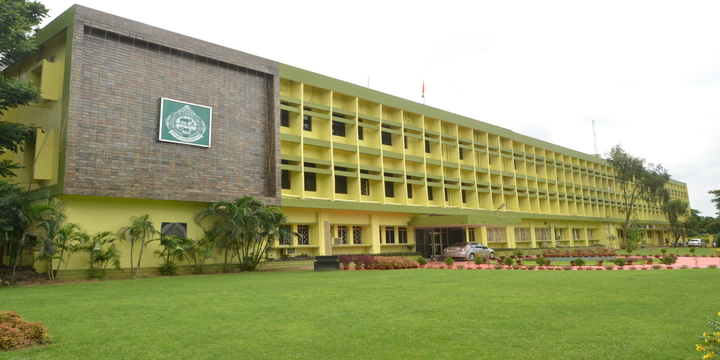
Orissa University of Agriculture & Technology (OUAT), Bhubaneswar was established in 1962.
It was established with only two Colleges of Agriculture and Veterinary Science, has made impressive record of service in the cause of quality education.
In the pace of decades the University has grown with seven colleges and one Centre for Post-Graduate studies with different departments. The University is marching forward with sacred mission on teaching, research and extension dedicated to overall growth of the State's economy.
OUAT developed linkages with the University of Missouri and Mississippi, a Land Grant University of the US, to strengthen its teaching, research and extension programmes. At present, the University has 8 constituent colleges.
The University has separate wings for Research, Extension Education and Planning, Monitoring & Evaluation. It came in to existence as the second Agricultural University. Constituent Colleges at Orissa University of Agriculture & Technology.
The Radhakrishnan University Education Commission of 1949 emphasised the need for establishing Agricultural Universities in India., Subsequently, the indo-American team consistitued under the Chairmanship of Dr. K.R. Damle (1955), the then Vice-president of Indian Council of Agricultural Research, suggested a system of education for Indian as followed in the Land Grant Colleges of USA. The Planning Commission Committee felt the inadequacy of trained personnel for substantial output in agricultural operations with the then set up of research, education and extension in Agriculture, Animal Husbandry and allied fields. In course of time, these recommendations led to the creation of the agricultural universities to accomplish the integration of teaching, research and extension.
In 1956, Dr. J.H. Longwell from the University of Misouri visited Orissa and had discussion with the State Government which resulted in a contract between the Government of India and the University of Missouri to provide assistance to the Agriculture and Veterinary Colleges of the State.
In 1960, a decision was taken to establish an Agricultural University in Orissa in the pattern of the Land Grant Colleges of USA and Dr. Ide P. Trotter joined the Utkal Krishi Mahavidyalaya on 1st April, 1960, as a consultant in Educational Administration. President Elmer Ellies of the University of Missouri, visited the Agriculture and Veterinary Colleges of Orissa in 1961 and had discussion with the State Government for establishment of the Orissa University of Agriculture and Technology.
VISION
OUAT is envisioned to be a globally recognised and locally relevant Premier Farm University in India providing leading-edge education, research, extension and outreach in agriculture and allied sciences that are life-enhancing, socially sensitive, environmentally responsible and economically beneficial in the current and emerging scenario of socio-economic-climatic-technological changes in India and globe. It will serve the state for providing template of sustainable agricultural development that would transform agriculture sector into the engine of growth of Odisha’s economy and provide livelihood security of farming community. The vision statement is paraphrased as follows.
- To get national and global recognition, the university will strive to build up its development model, which will be innovative, adaptable and scaled up so as to inspire other national farm universities to measure themselves and emulate.
- Leading-edge education with life-enhancing programmes will produce graduates, who will be adaptable humane citizens and innovative, contributing and motivated force to serve the state and the nation by advancing, sharing and applying knowledge and skill.
- Sustainable development of green, blue and white revolution in the state
- In the context of the emerging scenario of socio-economic-climatic-technological changes in India and globe, the technology will be socially sensitive, environmentally responsible, and economically beneficial.
- To meet the local problems and diversity in socio-economic ethnicity, the programme and policies will be prioritised with special drive on backward areas and the tribal agriculture.
- To improve the share of agriculture in Odisha’s economy, it will provide leadership in sharpening the competitive edge of the state agriculture through a package of appropriate strategies, public policies and programmes, technology services and investment support.
MISSION
Activities accelerating upward trajectory of the University
OUATians have aspiration to greatly improve university activities producing skilled human resources including high caliber graduates with knowledge and expertise, develop relevant technology and provide appropriate services to the farming community, the pathway of which has to run through the plan characterised by desire to consolidate our strengths, to integrate further our research, educational and extension activities, to optimise our infrastructure and accelerate our success. It requires reorientation and restructuring the programmes. The activities are to be built up together by the staff and students in every part of the University to ensure continuance of the journey with great vigour, centering around the original commitment.
PHILOSOPHY
Using tools developed over millennia, farming communities in Odisha have developed resilient agricultural systems, well adapted to social and environmental conditions unique to their locations. However, conditions have changed and are changing rapidly. To cope these changes, agricultural scientists and specialists have to partner with the farming community in the effort to meet the market needs of food, feed, fiber and fuel. This can be achieved by addressing contemporary agricultural problems with the most advanced scientific capabilities, while respecting earlier contributions of agriculturalists and traditional approaches to agriculture.
Uphold the values of academic freedom and creativity, and respect the rights of farmers and consumers to decide which technologies are most appropriate.
GOAL
Assisting production to consumption. Assist all members and sectors of Odisha’s food and agricultural system to reach their full potential in an environmentally and socially compatible and economically profitable way.
Developing human and farming community potential. The ultimate goal is to improve the quality of life including socioeconomic status, self-esteem, health and leadership abilities. OUAT's programs will examine how present and future research, education and policy in agriculture and natural resources affect individuals and their communities. Accordingly, it is to be dedicated to providing educational opportunities and science-based information to the farmers and other stakeholders to meet the challenges of the new millennium.
Enhancing sustainable use of agricultural resources. Food, feed, fuel and fiber generation depend on the efficient and sustained use of soil, water, air and solar radiation. The university will seek to improve the management and conservation of agricultural and natural resources that affect human welfare.
Developing food and other bio-based products for value-addition and new uses. The University programs will orient how technology is used to increase the market value of food, fee, fuel and fibre products.
| Streams | Mode | Duration | Eligibilty |
|---|---|---|---|
| Bachelor of Technology in Agricultural Engineering | Full Time | 4 Years | 10+2 |
| Streams | Mode | Duration | Eligibilty |
|---|---|---|---|
| Bachelor of Science in Agriculture | Full Time | 4 Years | 10+2 |
| Bachelor of Science in Forestry | Full Time | 3 Years | 10+2 |
| Bachelor of Science in Horticulture | Full Time | 4 Years | 10+2 |
| Master Of Science In Agriculture | Full Time | 2 Years | B.Sc |
| Master of Science in Bioinformatics | Full Time | 2 Years | B.Sc |
- Library
- Sports
- Laboratories
- Classroom
- Health Centre / Hospital
- Conference Hall
- Computer Lab